“Hovmöller said the idea of his construction of meteorological fields using a time-geographic coordinate representation was a mere lucky hit that emerged through creative spurt”
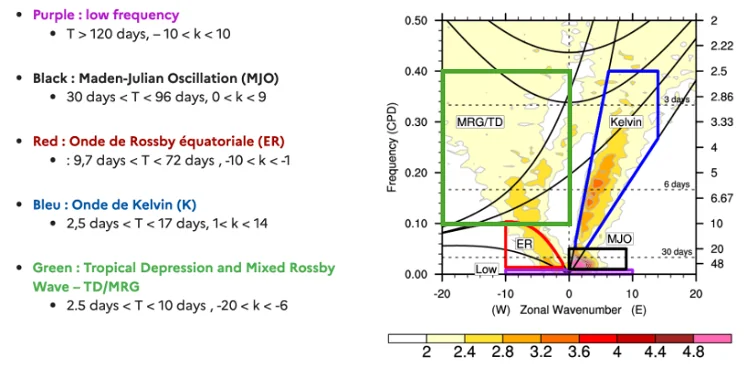
Recollect from previous post that climate and weather were compared to low and high frequency atmospheric states respectively, similarly in tropical waves, we have four of them: MJO, ER, CCKW & MRG as high frequency waves and a low frequency base state which dictates the walker cell ascent and descent geographies. The blogging community uses the term standing wave for denoting low-frequency base state quite often like any other household term. The interaction of one with the other drives the global weather especially in the tropics. Through principles of wave superposition, this NOAA blog post and this PSU post from a research lab beautifully demonstrates how these tropical waves interact to cause means and extremes in global weather.
A typical low frequency standing wave feature sets up based on the prevailing oceanic conditions involving the El-Nino Southern Oscillation (ENSO) and the Indian Ocean Dipole (IOD) phases, wherein its amplitude can be enhanced over time through the traversals of tropical waves and their associated wind bursts phenomena. It has a time period of > 4 months to a year.
Next, we elaborate in detail the history of the four high-frequency tropical waves “in the order of their discoveries” and how they are constructed using the Hovmöllers diagram.
Equatorial Rossby (ER, 1939): This is an east-west moving tropical wave and as the name suggests mainly affects weather conditions in the equatorial regions. The origin of this wave though is believed to be from the subtropical Rossby trains. The time period of recurrence can range from anywhere between 2 weeks to 2 months.
Mixed Rossby-Gravity (MRG, 1966): This is also an east-west moving tropical wave which originates from near the equator as they are equatorially-trapped and typically dissipate their energy in higher latitudes as they decay further moving away from equator. The time period of recurrence can range from anywhere between 2 days to 1 week.
Convectively-Coupled Kelvin Waves (CCKW, 1968): These are west-east moving tropical waves that primarily move across the tropics but are likely to be originating from the subtropics initiated by subtropical Rossby trains. They enhance convective activity in the form of thunderstorms or also help increase upper-level divergence of strong tropical cyclonic systems and influence mid latitude westerly troughs. The time period of recurrence can range from anywhere between 5 days to 2 weeks.
Madden Julian Oscillation (MJO, 1971): This was the most recently identified large-scale tropical wave which are west-east moving envelopes of convectively active swarms that are bounded by atmospheric Kelvin waves to its front/back and weaker Rossby waves sometimes to its back. This originates typically in the west Indian Ocean close to the equator that acts as a global heat source and propagate eastwards with increasing amplitude and interacting with other subtropical wave trains in the process. The time period of recurrence can range from anywhere between 30 days to 2 months.
Each of these tropical waves redistribute energies from the tropics to the subtropics and vice-versa. Since the tropical regions closer to the equator have the most consistent solar irradiation over a calendar year, it typically acts as a single heat source driving both global climate as well as weather. The reader is referred to this RMetS article and this MeteoFrancesite for further discussions on tropical waves.
Quoted from Anders Persson: “The Hovmöller time–longitude diagram might today be looked upon as just a convenient way to represent temporal evolutions of meteorological fields. But at its creation, the trough–ridge diagram played a crucial role in the development of early Numerical Weather Prediction.”
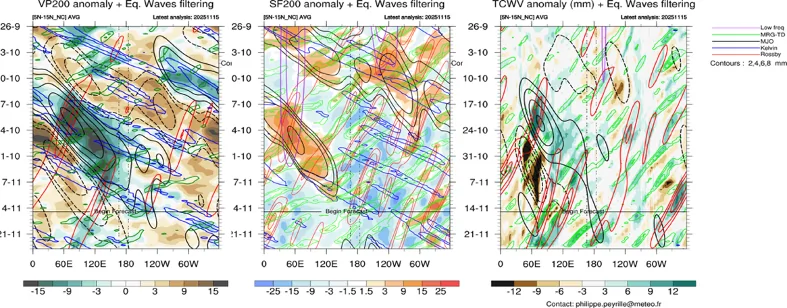
With this understanding on both the low frequency and high frequency wave features, it is important to know how these tropical waves drive synoptic-scale features within a large planetary scale phenomenon like the Indian Monsoon.